



US Breaks Ranks as UN Nations Renew Pledge to Halve Road Deaths by 2030
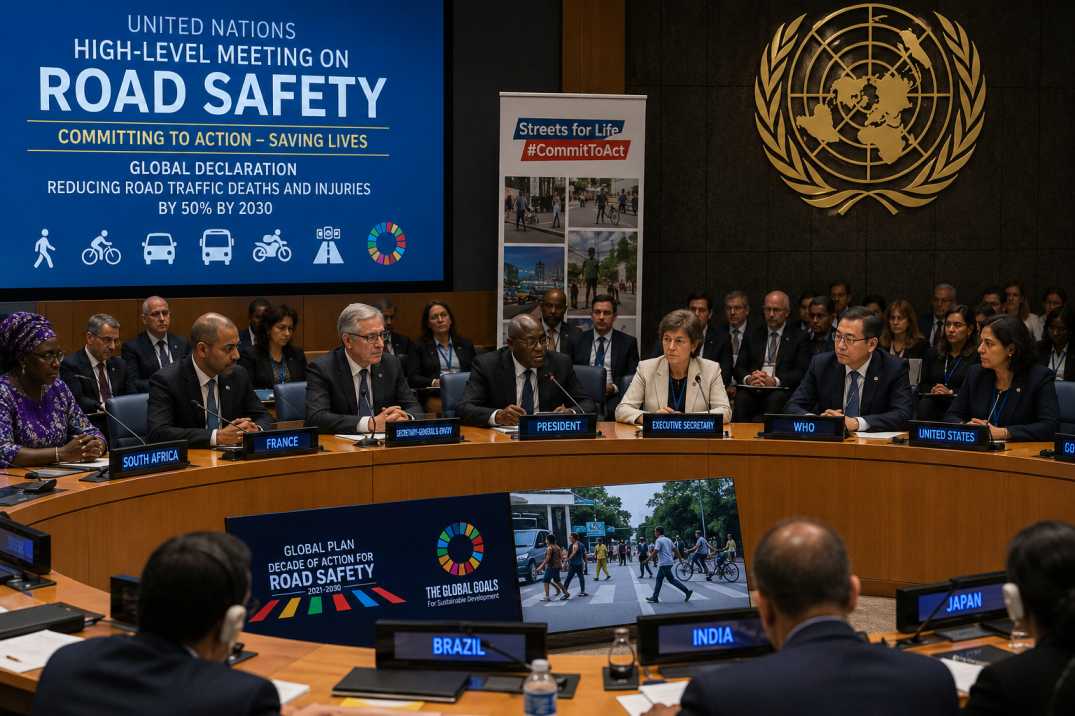
NEW YORK – World leaders have renewed their commitment to reducing road traffic deaths and injuries by at least 50 per cent by 2030 at the United Nations High-Level Meeting on Road Safety.
Still, the United States stood alone in voting against the progress declaration adopted by member states.
UN Declaration on Road Safety
The declaration, endorsed by 162 countries on Monday, calls on governments to set measurable national targets, timelines and budgets to accelerate road safety efforts.
It also encourages countries to integrate road safety measures into broader climate, environmental and urban development policies.
Why the US Voted Against the Declaration
The US delegate opposed the declaration, describing it as “mandate creep” and arguing that road safety should remain focused on engineering, sober driving and personal responsibility rather than being linked to global climate and environmental policies.
Rising Road Deaths in the United States
The vote came as new data highlighted worsening road safety trends in the United States. A study by the Institute for Health Metrics and Evaluation (IHME), published in The Lancet Public Health, found that the US was one of only six countries where road injury mortality rose significantly between 2010 and 2023, recording a 13.2 per cent increase.
Global Progress on Road Safety
Globally, however, the World Health Organization (WHO) reported a 21 per cent decline in road traffic deaths between 2011 and 2025.
Despite this progress, 1.34 million people died, and nearly 51 million were injured in road crashes in 2023, making road injuries the leading cause of death among people aged 10 to 39.
Low-Income Countries Bear the Heaviest Burden
Low-income countries continue to bear the heaviest burden, accounting for more than 90 per cent of global road deaths despite having fewer traffic crashes than high-income nations.
The mortality rate in low-income countries was 43.8 deaths per 100,000 people, compared with 7.5 deaths per 100,000 in high-income countries.
IHME researchers estimated that more than 200,000 lives could be saved each year through improved trauma care in low- and middle-income countries.
Dr Liane Ong, IHME senior research scientist and co-author of the study, said road injury outcomes depend not only on crashes but also on the systems designed to prevent them and protect victims after accidents occur.
Motorcyclists and Pedestrians at Greater Risk
Motorcyclists now account for nearly one-third of global road fatalities, according to WHO data, while pedestrians make up almost another third.
WHO officials warned that the rapid growth of ride-hailing, delivery services and new forms of mobility such as e-scooters and e-bikes presents fresh challenges for transport planners.
WHO Welcomes Strong Political Commitment
WHO Director-General Dr Tedros Adhanom Ghebreyesus praised member states for adopting what he described as a “strong political declaration” aimed at accelerating action to make roads safer for all users.
The declaration commits countries to improving speed management, road and land-use design, traffic rules, vehicle safety standards, data collection and enforcement of stronger road safety laws as part of the global effort to meet the 2030 target.